
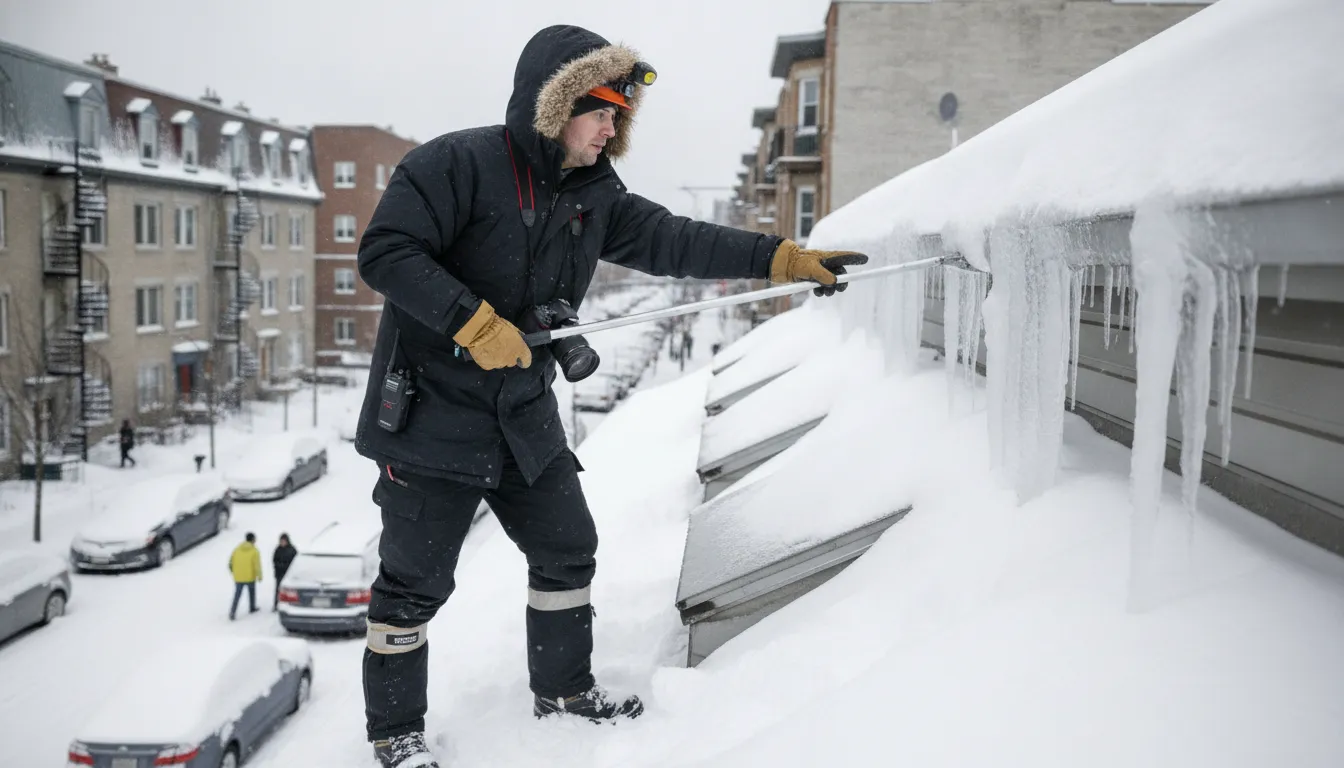
Montreal winter does not create a single maintenance challenge. Snow accumulation can place stress on roofs. Freeze-thaw cycles can redirect meltwater toward foundations. And a small heating or ventilation problem can become a costly emergency when a building is occupied or vacant.
Effective winter property management in Montreal combines preventive inspections, safe snow and ice control, roof and attic oversight, heating monitoring, and rapid emergency coordination. The approach must also reflect the different operational requirements of residential buildings, commercial properties, industrial sites, and absentee-owned assets.
For property owners, the objective is not simply to react after the first major snowfall. It is to establish clear protocols before winter, document conditions as they change, and ensure qualified support is available when weather exposes a weakness. That is why the right management approach begins with the particular risks of Montreal’s climate and the property portfolio itself.
Why Winter Property Management in Montreal Requires a Specialized Approach
Montreal winter places demands on a property that extend well beyond arranging a plow. Heavy snow, freeze-thaw cycles, ice formation, and extreme cold can affect roofs, building envelopes, heating systems, foundations, access routes, and tenant safety at the same time. A winter-ready management plan therefore needs to connect preventive inspections, maintenance coordination, emergency response, and clear reporting.
Generic winter checklists, such as those that focus on indoor maintenance, exterior upkeep, and sidewalks or parking lots, are useful starting points. Other guides emphasize inspections, heating systems, pipe protection, snow management, and sealing windows and doors. Those measures are necessary, but they do not replace a protocol designed around the building’s use, construction, occupancy, and risk profile.
Residential properties require continuity and close observation
For apartment buildings, condominiums, and rental homes, winter operations must protect residents while keeping essential systems reliable. That means coordinating snow and ice clearing, monitoring heating performance, identifying water-entry risks before meltwater reaches the foundation, and responding quickly when a tenant reports a failure. Routine inspections and documented follow-through matter because a minor issue can become a costly disruption when temperatures fall sharply.
Commercial and industrial buildings carry different operational risks
Commercial complexes, office buildings, and industrial properties require a broader control framework. Parking areas, loading zones, walkways, roof systems, mechanical rooms, HVAC equipment, and service access may all need different inspection and maintenance schedules. Industrial facilities can also have larger roof spans, more complex mechanical infrastructure, and operational dependencies that make an isolated winter failure more consequential. Managing these properties effectively means coordinating qualified service providers, prioritizing hazards, and maintaining an accurate record for owners, institutions, or trusts.
| Property Type | Key Winter Risks | Required Protocols | Monitoring Frequency |
|---|---|---|---|
| Residential (apartments, condos, rentals) | Heating failures, frozen pipes, tenant safety, snow accumulation on walkways | Heating checks, pipe insulation, snow clearing, tenant communication | Weekly minimum; daily during extreme cold |
| Commercial (offices, retail) | Roof snow load, parking/access ice, HVAC performance, tenant disruption | Roof monitoring, mechanical inspections, snow removal contracts, emergency plan | Bi-weekly with updates after each major snowfall |
| Industrial (warehouses, facilities) | Large roof spans, complex mechanicals, operational continuity, equipment vulnerability | Structural assessments, HVAC maintenance, vendor coordination, business continuity planning | Weekly with post-storm structural checks |
Local expertise turns winter maintenance into risk management
PGK Realty Services has served Greater Montreal property owners since 1986, bringing more than 35 years of experience across residential, commercial, and industrial portfolios. Its winter-critical maintenance model is built around specialized local knowledge rather than a one-size-fits-all checklist. PGK also serves clients in English and French, supports international investors and institutional clients. And provides 24/7 emergency response for events such as heating failures, ice dams, and roof snow-load concerns.
For owners seeking comprehensive property management in Montreal, the practical advantage is coordination. Someone is accountable for the details before, during, and after a winter incident, so ownership does not become a daily operational burden.
How to Prevent Ice Dams and Roof Snow Load Damage on Montreal Properties
Ice dams form when heat escaping through an attic warms the underside of the roof. Snow melts above the warmed area, then refreezes at colder eaves, creating a barrier that can force water beneath roofing materials. Montreal’s repeated freeze-thaw cycles make this risk particularly important for properties with complex roofs, older envelopes, or uneven attic conditions.
Control heat loss before it becomes a moisture problem
Start with an attic assessment rather than treating visible ice as an isolated maintenance issue. Natural Resources Canada identifies air leaks around chimneys, vents, plumbing pipes, and electrical boxes as sources of substantial heat loss and moisture-related problems, including ice dams. These penetrations should be sealed with appropriate materials, while insulation levels should be reviewed for continuity and adequate coverage.
Air sealing and insulation work should be coordinated with ventilation. Baffles, soffit intake paths, ridge or roof vents, and other components must work together to maintain a consistent roof temperature and manage attic moisture. Natural Resources Canada notes that even an insulated attic may benefit from improvements to air sealing and ventilation. A retrofit plan should therefore account for the building’s existing roof assembly and mechanical systems. As well as areas where ventilation may be obstructed, rather than adding vents without addressing the underlying air leakage.
Manage snow load with a documented safety protocol
Heavy snow accumulation can contribute to structural damage and leaks. Roof conditions should be monitored after significant snowfall and during warming periods, with attention to sagging, unusual sounds, blocked drainage, and water entry. Snow and ice removal from roofs and eaves is hazardous. The Government of Canada advises property managers to work in pairs or hire professionals for this task. It should not be assigned as an improvised individual exercise, particularly on multi-unit, commercial, or industrial buildings.
Professional property management services can coordinate qualified contractors, document conditions, and connect roof work with inspections of attics, drainage, and occupied areas. This integrated approach helps owners address the source of recurring ice dams while reducing the risk that a winter roof problem becomes an interior repair. Tenant-safety, or business-continuity issue.
Winterizing Vacant and Absentee-Owned Properties in Montreal
Vacant and absentee-owned properties require a more deliberate winter protocol because a minor failure can remain unnoticed until it becomes a major loss. Frozen pipes, heating interruptions, burst plumbing, and basement water entry can develop without the early warning that an occupied property provides.
Maintain heat, inspections, and early detection
Weekly vacant-property inspections are particularly important during periods of severe cold and rapid thawing. An inspection should look for loss of heat, unusual sounds from mechanical systems. Visible leaks, frozen or sweating pipes, water around the foundation, and signs of condensation or damage. It should also confirm that doors and windows are secure and that no developing issue has been concealed by snow. PGK’s vacant property inspection services support this preventive approach for seasonal and absentee owners.
Before a tenant leaves for an extended period. Confirm that the heating system is operating reliably and that indoor temperatures will remain at a minimum of 12 degrees C. Heating should not be turned off simply because a unit is unoccupied. A low-temperature alert, accessible shut-off plan, and clear emergency contact procedure provide additional safeguards, but they do not replace physical inspections.
Control meltwater before it reaches the building
Snow management should extend beyond walkways. Clear snow and ice away from the foundation before temperatures rise, since meltwater can enter the basement and contribute to flooding. This recommendation is especially important where the property has previous water damage, foundation cracks, poorly sealed basement windows, or exterior drainage that directs water toward the building. Property grading should move water away from the structure, not toward it. These risks are documented by the Government of Canada in its guidance on clearing snow and ice around a home: preventing flood damage.
When a heating failure, burst pipe, or sudden leak occurs, response time matters. PGK provides 24/7 emergency response so an issue at an unoccupied property can be escalated promptly rather than waiting for the owner to return or a neighbour to notice it.
24/7 Emergency Response: Managing Winter Crises Before They Escalate
Montreal winter emergencies rarely arrive at a convenient hour. A heating failure can quickly compromise tenant safety, while a burst pipe, roof leak. Or ice dam flooding can cause extensive damage before a property owner is able to reach the building. Effective response therefore depends on more than having a list of contractors. It requires a defined escalation process, reliable access to the property, and the authority to coordinate the appropriate intervention immediately.
PGK provides 24/7 emergency response for winter events including heating failures, ice dams, and roof snow load issues. This capability is supported by 24-hour superintendent availability and established vendor networks, allowing urgent maintenance coordination to begin without waiting for normal business hours. Owners can review PGK’s professional property management services to understand how emergency support fits within a broader operating model.
Prevention begins before the emergency call
Emergency readiness is strongest when it is connected to routine inspections. Regular site checks can identify abnormal heating performance, moisture intrusion, blocked drainage, or developing roof concerns before a failure becomes an after-hours crisis. During freeze-thaw conditions. Clearing snow and ice around the foundation is also important because meltwater can enter through vulnerable areas and contribute to basement flooding, as noted by the Government of Canada.
This preventive approach is particularly valuable for commercial and industrial properties, where a heating interruption. Water event, or structural concern can affect operations, occupants, equipment, and multiple stakeholders at once. Winter-critical maintenance must be coordinated according to the building’s use and risk profile, not treated as a generic seasonal checklist.
Clear reporting for institutional owners
For financial institutions, trusts, and international investors, crisis management also includes disciplined documentation. A professional team should record the incident, response times, contractors engaged, remedial actions, and outstanding recommendations. Fiduciary-grade reporting gives owners and stakeholders a clear account of how winter risks were managed and what follow-up is required.
With professional oversight, owners are not left to manage vendor calls, tenant communications, and urgent decisions from a distance. PGK’s role is to handle the operational burden, coordinate the response. And provide the information needed for informed oversight, giving property owners greater peace of mind throughout the winter.
How to Choose a Winter Property Management Partner in Montreal
Winter readiness should be assessed as an operating capability, not simply a promise to arrange snow removal. Ask how the management firm prepares buildings before severe weather, coordinates vendors during an incident, documents inspections, and communicates decisions to owners, tenants, trusts, or financial institutions.
Look for demonstrated Montreal experience
A credible partner should understand the requirements of residential, commercial, and industrial properties in the Greater Montreal area. PGK Realty Services has served property owners since 1986, bringing more than 35 years of local experience to winter-critical maintenance. That background matters because snow, freezing conditions, meltwater, heating failures, roof stress. And access issues require coordinated attention across the property, not an isolated response to the most visible problem.
Test the response model before an emergency
Confirm that the firm offers bilingual English/French communication and can provide 24/7 emergency response. Ask whether it maintains established vendor networks for snow removal, emergency repairs, heating issues, and water-related incidents. A strong process should also include routine checks, clear escalation procedures, and reporting that lets an owner understand what occurred, what was authorized, and what remains outstanding.
For vacant or remotely owned properties, weekly inspection protocols are especially important. Regular visits can identify heating failures, leaks, access problems, or accumulating snow before a minor condition becomes a major loss. Owners can also review whether the firm provides vacant property inspection services as part of its operating model.
Evaluate reporting, insurance, and investor support
International owners from France, Germany, England, Hong Kong, and the Bahamas may need dependable oversight without being physically present. Institutional clients, trusts, and financial institutions should look for institutional-grade reporting and compliance-minded coordination rather than informal updates. Bilingual service supports communication with local stakeholders while maintaining a professional owner experience.
Finally, ask whether the provider can review related cost and risk considerations. PGK offers a free insurance evaluation for commercial and residential properties, with documented savings of up to 40% on premiums when applicable. Treat that figure as an evaluation outcome, not a guaranteed result, and request a proposal that reflects the property’s actual requirements.
Frequently Asked Questions
How can I prevent frozen pipes in my Montreal property during winter?
Maintain reliable heat throughout the building, inspect doors and windows for drafts, and monitor vulnerable areas such as basements, mechanical rooms, and exterior walls. For vacant or absentee-owned properties, scheduled inspections can identify heating failures, leaks, or unusual temperature changes before they become major losses. Water shutoff procedures and emergency contacts should also be documented in advance.
What is included in professional snow and ice management for Montreal buildings?
A complete program covers more than clearing the main entrance. It should address roofs and eaves, sidewalks, walkways, parking areas, loading zones, drainage paths, and building entrances. Roof snow and ice removal should be performed by professionals or by properly supported teams, since the work presents significant safety risks. Canada.ca also recommends clearing snow and ice around foundations to reduce the risk of meltwater entering the building: Canada.ca flood-prevention guidance.
How often should I conduct winter property inspections in Montreal?
Inspection frequency should reflect the property’s occupancy, heating systems, exposure, age, and known vulnerabilities. Vacant and seasonal properties require at least weekly checks as part of a documented preventive-maintenance program. Occupied residential, commercial, and industrial buildings also need routine inspections throughout the season, with additional checks after heavy snowfall, rapid thawing, extreme cold, or a reported mechanical issue.
Why is winter maintenance critical for investment properties in Montreal?
Winter maintenance protects the asset, supports tenant safety, and limits the escalation of roof, heating, plumbing, drainage, and access problems. Clearing snow around the foundation helps manage meltwater, while early detection of heating failures and leaks can reduce disruption and repair complexity. For international and institutional owners, a coordinated local response also provides clearer reporting and less day-to-day operational burden.
Ready to Request a Proposal for Winter Property Management?
A well-defined winter management plan helps property owners coordinate seasonal maintenance, respond to weather-related issues, and protect the continuity of residential, commercial, or industrial operations. For a management approach aligned with your property’s needs, request a proposal from PGK Realty Services. Share your requirements, and the team can discuss the appropriate next steps for your portfolio.