For an investor, a property inspection is not merely a condition check completed before signing. It is an early test of the building’s likely demands on capital, maintenance coordination, tenant operations, and insurance planning. The most useful report helps distinguish an immediate safety concern from a repair that can be scheduled and budgeted over time.
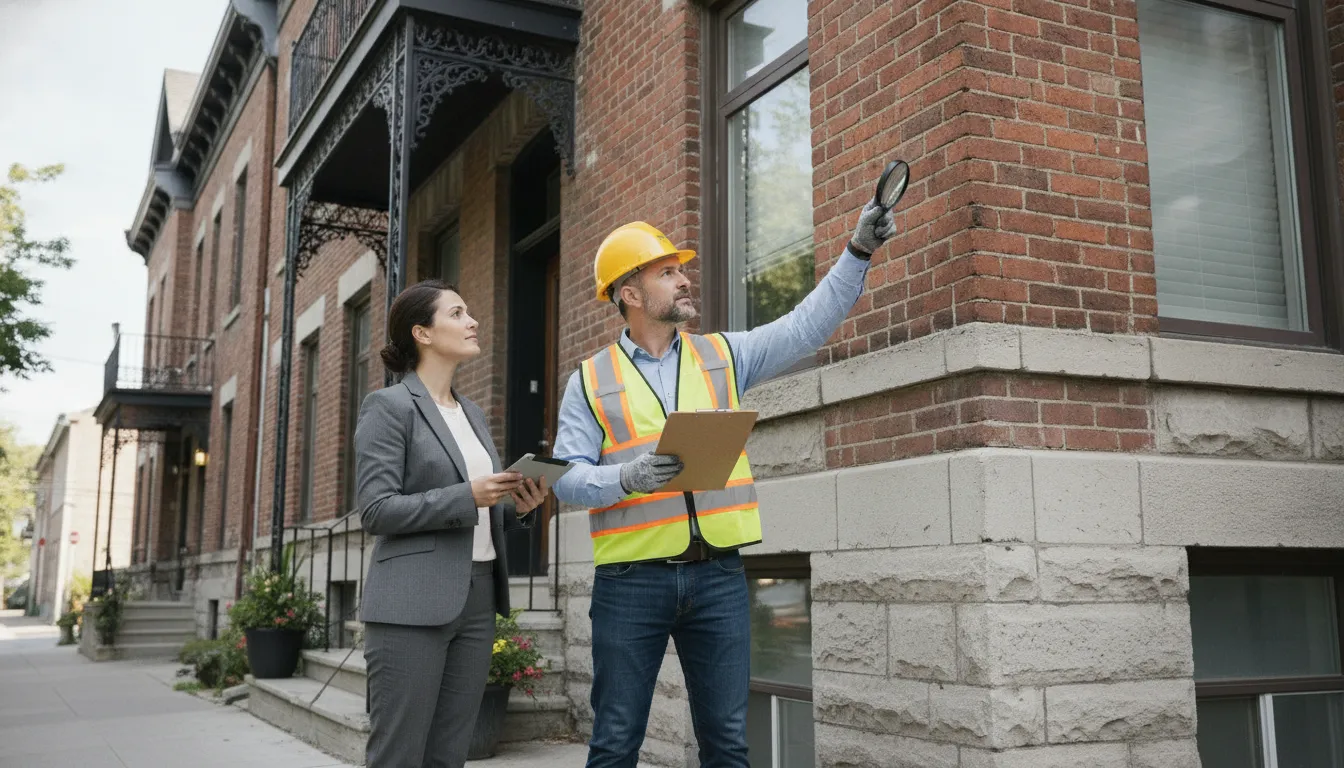
A pre-purchase property inspection Montreal evaluates the building’s principal components and documents defects, damage, and potential safety concerns before acquisition. For investors, those findings provide a practical basis for estimating near-term repairs, planning ongoing property management, and deciding whether the purchase terms reflect the asset’s true operating requirements.
Canada’s Office of Consumer Affairs recommends reviewing whether an inspection report covers the main systems and includes clear photographs and explanations. In Quebec, the BNQ 3009-500 standard is intended to harmonize residential inspection practices during real estate transactions. The scope, evidence, and limitations of that report matter when translating observations into an ownership plan.
Request a property management proposal to understand how professional property management can support your Montreal investment after the inspection.
What Does a Pre-Purchase Property Inspection in Montreal Cover?
A serious inspection examines the property as an interconnected operating asset, not merely as a collection of visible defects. The review typically considers the building envelope, structural condition, roof, electrical and plumbing systems, heating, ventilation and air conditioning, and other major components that may affect safety, durability, and future ownership decisions.
The building envelope includes exterior walls, windows, doors, visible masonry, drainage details, and other elements that separate the interior from Montreal’s weather. The inspector is looking for signs of water entry, deterioration, inadequate maintenance, or conditions that warrant further investigation. Structural observations may include the foundation, framing, floors, walls, and other accessible components. These observations are not a substitute for specialized engineering or technical assessments where a material concern is identified.
Roofing is assessed for visible condition, drainage, age-related deterioration, and indications of moisture intrusion where accessible. Electrical and plumbing reviews generally focus on observable installation conditions, apparent deficiencies, and the performance of accessible fixtures and systems. HVAC and other major systems are considered from an operating and condition perspective, with limitations clearly identified when equipment cannot be safely or fully tested during the visit.
| System. | What the Inspector Assesses. | Typical Investor Concern. |
|---|---|---|
| Building envelope. | Exterior walls, windows, doors, masonry, drainage details. | Water entry and deterioration that trigger early capital work. |
| Structure. | Foundation, framing, floors, walls, visible settlement patterns. | Movement or settlement requiring a structural engineer’s opinion. |
| Roofing. | Visible condition, drainage, age-related wear, moisture signs. | Remaining service life and the cost of postponing replacement. |
| Electrical and plumbing. | Accessible installations, apparent deficiencies, fixture performance. | Outdated components and renewal requirements in older buildings. |
| HVAC and major systems. | Operating condition and observable performance within stated limits. | Replacement exposure that belongs in first-year reserves. |
Quebec’s BNQ 3009-500 standard was introduced to harmonize inspection practices for residential buildings involved in real estate transactions. It provides a useful framework for understanding what a properly organized inspection should address. While the actual scope still depends on the property’s configuration, accessibility, season, and the inspector’s stated limitations; the standard does not eliminate the need to read the engagement terms carefully.
What the Written Report Should Include
The report is the inspection’s decision-making record. Government consumer guidance recommends asking for a sample report and confirming that it is understandable, covers the home’s main systems, and includes photographs and explanations. A useful report should distinguish observed conditions from recommendations for additional assessment. Identify safety or performance concerns, and make clear which areas were inaccessible or outside the inspection scope.
For an investor, the most valuable review is not simply a list of deficiencies. It is a structured basis for deciding which items require immediate attention, which belong in planned capital maintenance, and which should be investigated before a transaction proceeds. That distinction helps turn a technical inspection into a more disciplined acquisition and ownership decision.
For the BNQ context, see the Quebec government’s overview of BNQ 3009-500. The Office of Consumer Affairs guidance on home inspections also explains why a written, photo-supported report matters.
Montreal-Specific Issues Every Property Buyer Should Know
Montreal properties must be evaluated in the context of their soil conditions, construction history, and building age. A technically competent inspection does more than identify visible defects. It helps a buyer distinguish between ordinary maintenance, conditions requiring specialist investigation, and risks that may materially affect future ownership.
Foundation Settlement and Clay Soils
Clay soils are common in the St. Lawrence Valley and can present particular challenges for foundations. Because clay may compress or change behavior with variations in moisture and loading, settlement can place stress on foundation walls and other structural elements. The Régie du bâtiment du Québec explains the risks associated with clay soils, including conditions that can contribute to cracking or movement.
During an inspection, the objective is not to diagnose every structural condition from visual evidence alone. Inspectors look for patterns such as stepped or recurring cracks, uneven floors, sticking doors, water infiltration, and signs of prior repairs. Where the findings suggest movement rather than routine shrinkage, the buyer should obtain an opinion from an appropriately qualified structural professional before treating the issue as a standard repair item. That distinction matters when assessing both transaction risk and the capital planning required after closing.
Aging Infrastructure in Older Montreal Buildings
Many Montreal properties have accumulated several generations of building systems. An inspection should therefore examine the condition and apparent serviceability of plumbing, electrical components, roofing, drainage, the building envelope, and other major systems within the scope of the engagement. The report should make clear what was observed, what could not be inspected, and which conditions warrant follow-up.
For an older building, a buyer should read beyond isolated defects. Corrosion, outdated distribution components, recurring moisture, patched roofing, or evidence of deferred maintenance may indicate a broader renewal requirement. The practical question is whether the property can be operated reliably with planned maintenance or whether several systems may compete for capital at the same time. In a multi-unit, commercial, or mixed-use acquisition, that distinction can influence reserves, financing discussions, and the timing of improvements.
How Inspectors Handle Vermiculite and Asbestos
Buildings constructed between 1930 and 1990 may contain asbestos-containing materials, and vermiculite insulation may still be present in some properties. The Gouvernement du Québec advises that potentially asbestos-containing materials should not be disturbed. An inspector may identify suspect materials and recommend further assessment, but sampling, removal, or remediation should be handled by a qualified contractor or certified laboratory as appropriate.
Buyers should not remove insulation, open concealed areas, or conduct informal sampling to resolve uncertainty. The responsible path is to document the location, restrict disturbance, and obtain qualified advice on testing or management. That approach protects occupants, preserves evidence, and gives the buyer a more reliable basis for negotiating conditions and planning future work.
How a Pre-Purchase Property Inspection Report Informs Management Costs
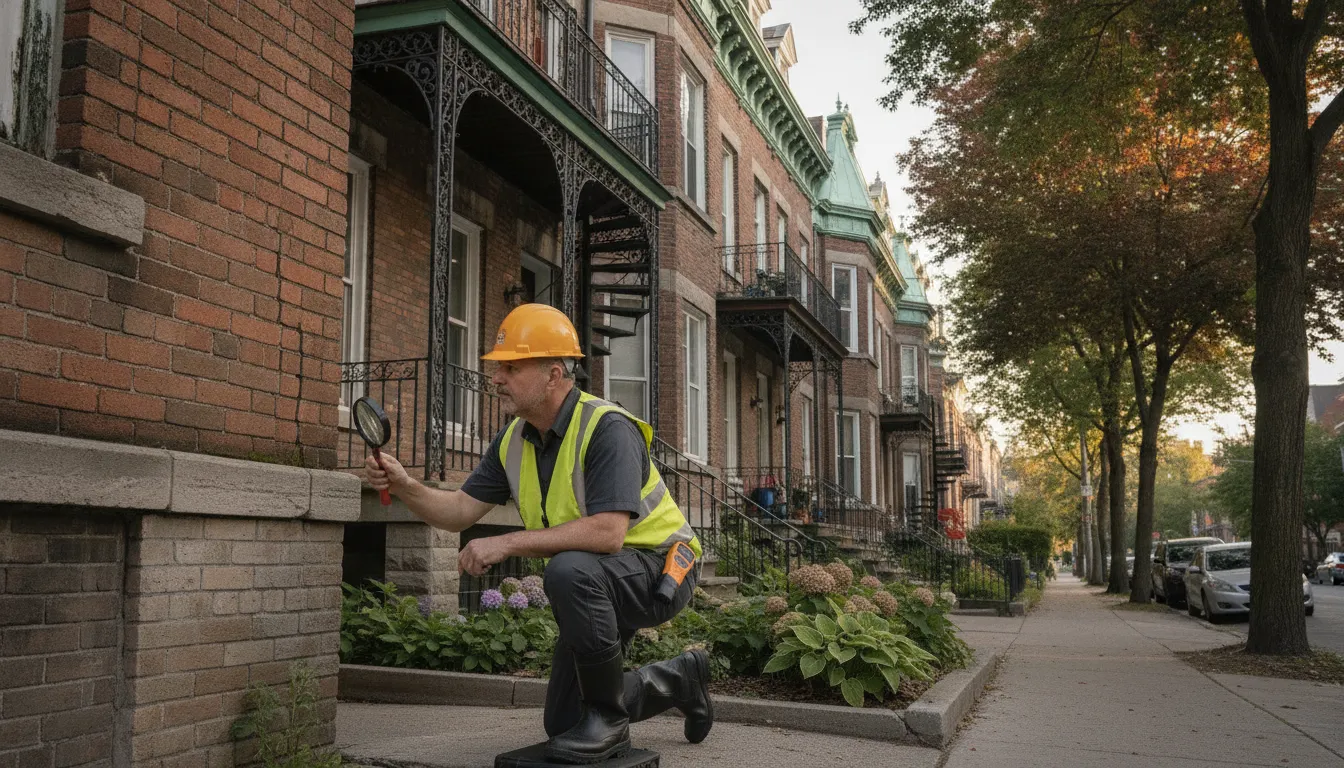
An inspection report should be read as an early operating-cost document, not merely as a record of defects. Its findings help an investor distinguish between a property that is operationally manageable and one that requires substantial capital planning immediately after acquisition. The Government of Canada notes that a complete report can inform purchase choices and identify repairs that may need to be addressed, creating a practical basis for both due diligence and negotiation. Read the government guidance on home inspections.
Reading the Report as an Operating Budget
Start by classifying observations according to their likely effect on ownership costs. Deferred maintenance, water infiltration, or deteriorated exterior elements may require attention before they become tenant-facing or operational problems. A roof or building-envelope finding should be considered in relation to its remaining service life, the consequences of postponement, and the possibility of related interior damage. The report may not provide a contractor’s quotation or a final lifecycle forecast, but it can identify where those investigations belong in the first-year plan.
The same discipline applies to electrical, plumbing, heating, and other major systems. Age, visible deficiencies, and safety concerns can signal future repair or replacement exposure. Property inspections can identify components that are defective, damaged, or unsafe, which is directly relevant when establishing maintenance reserves and prioritizing capital work. Professional property inspections can provide an additional condition-focused perspective as an owner builds an operating plan.
For an investor, the objective is not to convert every observation into an immediate expense. It is to separate urgent corrective work from predictable lifecycle planning and routine maintenance. That distinction improves the quality of projected net operating income, reserve assumptions, and cash-flow scenarios. It also helps an owner ask more precise questions of contractors, insurers, lenders, and property managers before closing.
Findings can also strengthen the negotiation strategy. Material defects, safety issues, or clearly documented deferred maintenance may support a request for repairs, a credit, a price adjustment, or additional investigation. The appropriate response depends on the asset, the evidence, and the transaction terms. An inspection report is therefore a decision-making tool, not an automatic valuation instruction.
Finally, preserve the report as a baseline for post-acquisition management. Comparing future inspections and work orders against the original condition record helps identify recurring issues. Prioritize spending, and demonstrate that maintenance decisions are being made deliberately rather than reactively.
Why Professional Property Managers Inspect the Properties They Operate
A pre-purchase report captures the condition of a property at one point in time. It does not, by itself, manage the risks that emerge after closing. Professional oversight converts that initial information into an operating discipline: observed conditions are tracked, maintenance is coordinated, and issues are addressed before they become disproportionate liabilities.
From Inspection to Ongoing Oversight
For an investor, the value of an inspection is realized through the decisions that follow. A finding concerning moisture, equipment, common areas, or a vacant unit should inform the maintenance plan, operating priorities, and reserve assumptions. Without a system for revisiting those conditions, even a well-prepared acquisition file can become disconnected from the property’s day-to-day reality.
PGK Realty Services provides that bridge for owners of residential, commercial, and industrial properties. Since 1986, the bilingual Montreal property manager has supported owners who require accountable coordination rather than a series of disconnected vendor interactions. Its management approach includes condition tracking, maintenance coordination, reporting, and ongoing communication, allowing owners to understand what has changed and what action is being taken.
Vacant properties require particular discipline. Unoccupied spaces can develop problems without a tenant present to report them, while seasonal conditions and unauthorized access can increase exposure. PGK maintains weekly vacant-property inspection protocols, documenting conditions and escalating concerns through the appropriate maintenance channel. Owners evaluating vacant home inspection services should consider not only the inspection itself, but also how observations will be recorded and acted upon over time.
That continuity also matters when a problem requires immediate attention. PGK’s 24-hour emergency response capability gives owners a defined point of contact when an urgent building issue cannot wait for a routine review. The objective is not to eliminate every unexpected event, but to shorten the distance between detection, decision, and intervention.
For investors who acquired a property based on a carefully reviewed report, professional supervision helps protect the return assumed in the acquisition model. Regular observation can support more deliberate capital planning, preserve tenant and asset conditions, and reduce the risk that a manageable defect becomes an avoidable operating disruption. Owners can review PGK’s property inspection services as part of a broader, custom management proposal.
Do You Really Need a Pre-Purchase Property Inspection in Quebec?
Quebec buyers are not legally required to commission a property inspection before completing a purchase. That does not make an inspection discretionary from an investment perspective. It is one of the few structured opportunities to identify defective, damaged, or unsafe components before the transaction becomes an ownership obligation. The resulting information can affect the purchase decision, the terms of negotiation, and the capital required after closing.
For investors, the risk calculation becomes especially important in a buyer’s market. A seller may be more willing to accept an offer that waives an inspection condition, or a buyer may feel pressure to remove that clause to appear more competitive. That choice can reduce friction during negotiations, but it also transfers uncertainty to the purchaser. The absence of an inspection does not remove latent defects, deferred maintenance, or safety concerns. It removes a formal opportunity to investigate them before committing capital.
Why inspector credentials matter
Since October 1, 2024, the Régie du bâtiment du Québec (RBQ) has issued certificates to residential building inspectors who perform pre-purchase inspections for real estate transactions. The RBQ states that this certificate will become mandatory for all inspectors wishing to practise in Quebec on October 1, 2027. Buyers should therefore confirm the inspector’s current credentials and understand precisely what the engagement covers. See the RBQ guidance on pre-purchase inspections for the applicable certification timeline.
How to protect the investment decision
A professional inspection is not a guarantee that every future issue will be discovered, and it is not a substitute for specialized assessments where the report identifies a concern. It is, however, a disciplined basis for deciding whether to proceed, renegotiate, commission further testing, or revise the acquisition budget. The written report should be clear, cover the property’s main systems, and include photographs and explanations. Where available, selecting an inspector affiliated with a professional association or order may also provide additional protection through liability insurance, as noted by Canada’s Office of Consumer Affairs.
For a rental, commercial, or multi-unit acquisition, the inspection should be read alongside the property’s operating history and anticipated maintenance program. Waiving an inspection may be commercially rational in a narrowly defined situation. But it should be an explicit, documented risk decision rather than an assumption that the building is sound.
Request a property management proposal by contacting PGK Realty Services to turn your inspection findings into a workable ownership plan.
Frequently Asked Questions
How much does a pre-purchase inspection cost in Montreal?
There is no responsible one-size-fits-all price. The fee depends on the property’s size, age, construction, systems, and the inspection’s scope. Request a written quote that identifies what is included, what requires a specialist, and whether the report will document photographs and explanations.
What does a pre-purchase property inspection cover?
A qualified inspection reviews the main accessible systems and components of the building, looking for conditions that may be defective, damaged, or unsafe. The report should explain significant observations clearly, include photographs, and distinguish items that require immediate attention from those suitable for planned maintenance.
Is a pre-purchase inspection required when buying in Quebec?
No. Quebec does not legally require buyers to have a property inspected before completing a purchase. From an investment perspective, however, the inspection remains one of the few structured opportunities to identify defective, damaged, or unsafe components before the transaction becomes an ownership obligation, and its findings can support repair budgeting, purchase decisions, and negotiations rather than leaving ownership costs to assumption.
How should investors choose an inspector in Montreal?
Ask about relevant experience, inspection scope, sample reports, professional affiliations, and liability insurance. The RBQ began issuing certificates to residential building inspectors performing pre-purchase inspections on October 1, 2024, and the certificate becomes mandatory for all such inspectors in Quebec on October 1, 2027. Review the RBQ requirements before appointing an inspector.
What should investors do if vermiculite insulation is found?
Do not disturb or remove suspected vermiculite yourself. Arrange an assessment by a qualified professional who can determine whether hazardous materials are present and recommend appropriate next steps. Treat the finding as a due-diligence and potential capital-planning issue, not as a basis for an unsupported repair estimate.
Ready to Request a Property Management Proposal?
A clear understanding of a property’s condition can help investors plan ownership responsibilities and ongoing management with greater confidence. PGK Realty Services can review your needs and prepare a tailored proposal for the property and portfolio you are considering. Request a property management proposal by contacting PGK Realty Services.